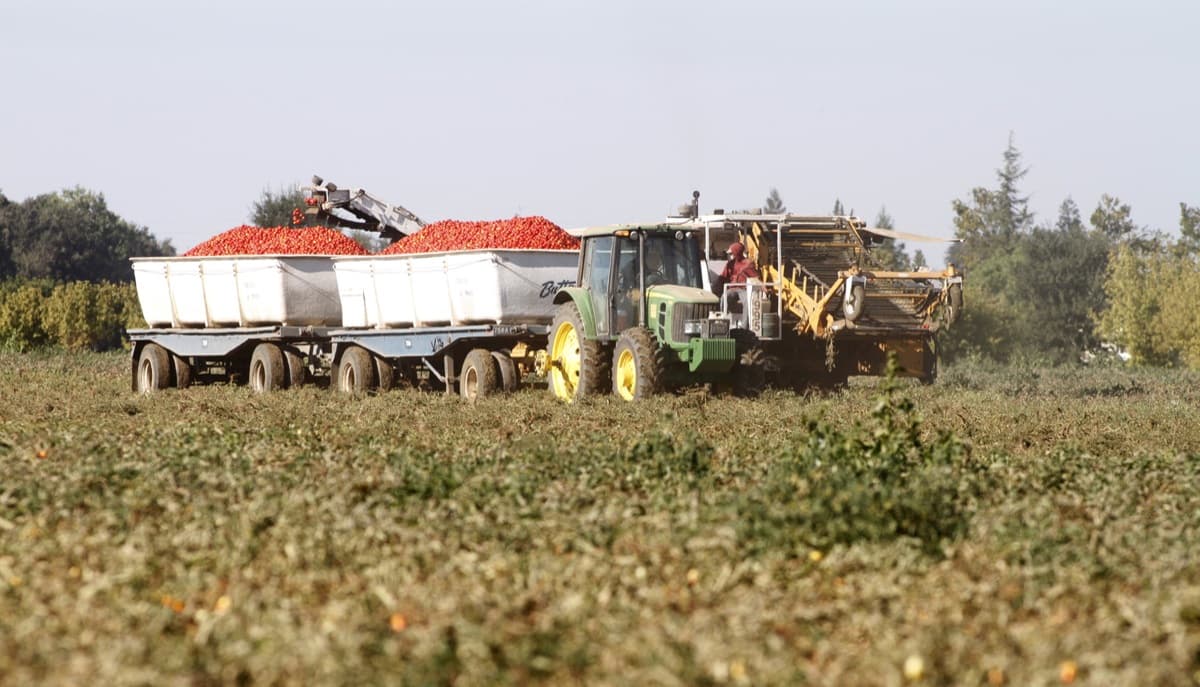
At UC Davis, the water going onto a processing-tomato plot was part of the experiment, not merely the crop’s daily allowance. Each irrigation decision became a way to ask what the plant could do with less—and what might show up in the soil when the answer was not enough.
The UC Davis study examined deficit irrigation in California processing tomatoes, with attention to two problems that are often managed in separate columns: soil-borne disease development and yield quality.
Less Water, More Variables
Deficit irrigation is easy to describe and harder to manage. The basic move is to supply less water than the crop could use at full demand. The consequences, however, do not arrive in a neat line. A plant may encounter a drier root zone while disease pressure, fruit development, harvest timing, and processor expectations continue on their own schedules.
The trials were conducted in 2021 and 2022. That detail matters because the study was built around field conditions rather than a small container experiment, giving the researchers a setting where irrigation choices met the ordinary complications of California tomato production.
The Root Zone Keeps Score
For growers, the useful question is not simply how many irrigation sets can be removed. It is whether a reduction changes the balance between water savings, plant stress, disease development, and the quality of the harvested crop. The study was designed to make that relationship more visible.
That approach fits within a broader California research effort around climate adaptation. A CDFA specialty-crop report brings together scientific information and grower-facing recommendations on resilience, where water management is less a single technology than a series of field decisions.
Soil is the awkward middleman in those decisions. It stores water, hosts roots, and can also harbor pathogens. Research on amendments has made a similar point from another direction: a CDFA-supported biochar project notes that reported benefits are often strongest in marginal soils and that many experiments have been small or short-term. Irrigation research faces its own version of that problem—results need to survive contact with an actual field.
A Field Decision, Not a Water-Saving Slogan
The UC Davis work does not turn deficit irrigation into a universal prescription for processing tomatoes. Its value is narrower and more useful: it places water scarcity beside plant health and yield quality, so a grower considering a reduced schedule has more than the water meter to consult.
That distinction is important for California operations managing fields with different soil textures, disease histories, and irrigation systems. A schedule that looks efficient on paper may carry a different biological cost in a field where the root zone dries quickly or where soil-borne disease is already a concern.